Working Outdoors in Winter: 9 Things UK Law Says About the Cold
Working outdoors in winter in the UK: there is no legal minimum temperature, but 9 rules on risk assessment, welfare, PPE, breaks, wind and daylight do apply.
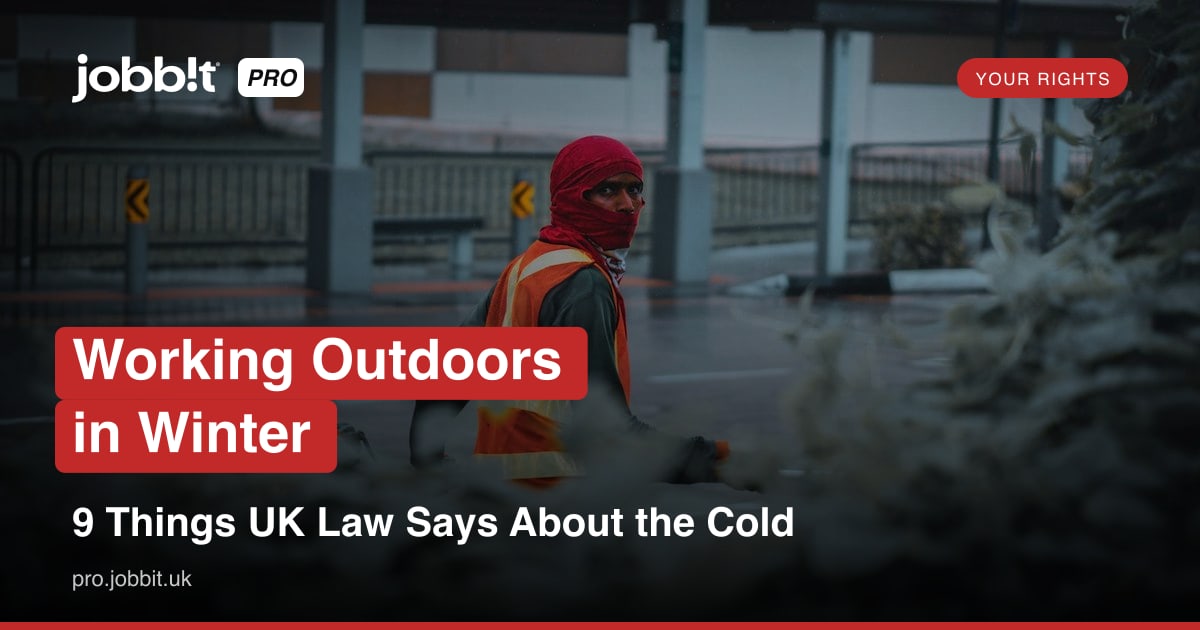
There is no legal minimum temperature for working outdoors in the UK. The 16°C figure people quote is indoor guidance and does not apply to a site or a roof. What the law does require is a risk assessment that covers cold, welfare facilities on construction sites with somewhere warm and dry, protective clothing paid for by the employer, a 20-minute break in a shift over six hours, and a stop to work at height when the weather makes it unsafe.
Every January someone on a site says "it's too cold to work, it's the law". It is not, and the person who believes it is usually the one standing in the cold with no say. The Health and Safety Executive recorded 124 workers killed at work in 2024/25 and a provisional 126 in 2025/26, with construction the deadliest sector at 25 deaths; slips, trips and falls on the same level were 30% of all non-fatal injuries reported by employers, and they peak when the ground freezes. Working outdoors in winter is governed by a dozen rules spread across six sets of regulations, and most tradespeople have read none of them because nobody puts them in one place.
Below: the nine rules with the regulation each comes from, what each means on a Tuesday in February, who is bound when you are self-employed, the daylight problem that cuts a December working day to under seven hours in Glasgow, the first aid the NHS wants you to know, and the clause that stops a weather day becoming an unpaid day.
Want weather clauses in your quotes and a client message ready when the forecast turns? A free Jobbit Pro profile brings briefed jobs and an agent for the admin, with 300 free credits.
How we checked
- The legislation itself, read on legislation.gov.uk on 24 October 2026, not a summary of it.
- HSE's own guidance pages on temperature, outdoor working, construction welfare and work at height.
- Government statistics from HSE's fatal injury and kind-of-accident releases.
- The NHS for first aid, and the UK Health Security Agency for the cold-weather alert system.
- Where the law is silent, such as whether a client can be charged for a weather cancellation, we say so rather than guess.
The 9 rules at a glance
| Rule | Where it comes from | What it means on site |
|---|---|---|
| 1. No legal minimum outdoor temperature | Workplace Regulations 1992, reg 7; HSE | "Reasonable" indoor temperature only; the 16°C and 13°C figures are guidance, and construction sites are excluded from that regulation |
| 2. Cold must be risk-assessed | Management Regulations 1999, reg 3 | Employers and relevant self-employed people must assess the risk and act on it |
| 3. Sites must give shelter from the weather | CDM 2015, reg 34(2) and Schedule 2 | Outdoor sites arranged to protect from adverse weather; drying facilities, hot water, somewhere to boil a kettle, kept at an appropriate temperature |
| 4. Warm clothing counts as PPE | PPE Regulations 1992, extended in 2022 | Provided free to employees and to "limb (b)" workers, not just staff on PAYE |
| 5. A 20-minute break after six hours | Working Time Regulations 1998, reg 12 | An uninterrupted break, and HSE adds warm-up breaks and hot drinks for cold work |
| 6. Weather stops work at height | Work at Height Regulations 2005, reg 4(3) | Only when conditions do not jeopardise safety; HSE says winds over 23 mph affect a person's balance on a roof |
| 7. Self-employed in construction are never exempt | Health and Safety at Work Act s3(2); SI 2015/1583 | Construction, gas, agriculture, asbestos, GMOs and railways are prescribed; the "no employees, no risk" exemption does not reach them |
| 8. Cold-Health Alerts are a signal, not a law | UKHSA, 1 November to 31 March, England | Yellow, amber and red alerts aimed at the health service; no duty on employers, but evidence for your risk assessment |
| 9. Lighting is your problem when daylight is not | CDM 2015, reg 35 | Site lighting required, natural where practicable; on 21 December London has 7 hours 49 minutes of daylight and Glasgow 6 hours 58 |
Rule 1: the temperature nobody can quote
Regulation 7 of the Workplace (Health, Safety and Welfare) Regulations 1992 says the temperature in workplaces inside buildings "shall be reasonable". The Approved Code of Practice that goes with it says that should normally be at least 16°C, or 13°C where much of the work involves rigorous physical effort. That is where the figures come from, and three things limit them: they are guidance rather than a legal limit, they apply indoors, and regulation 3 excludes construction sites covered by CDM altogether. HSE's own temperature page says plainly that there is no maximum workplace temperature, and its cold-stress page says HSE does not provide guidance on cold stress. Anyone who tells you the law sets a number for outdoor cold is repeating a myth.
Rule 2: the assessment that does apply
What does apply everywhere is regulation 3 of the Management of Health and Safety at Work Regulations 1999: a suitable and sufficient assessment of the risks to employees and to anyone else affected by the work, with a parallel duty on relevant self-employed people. Cold is a risk like any other. HSE's outdoor working page lists the controls it expects for cold: appropriate protective clothing, mobile facilities for warming up with soup or hot drinks, more frequent rest breaks, delaying the work until a warmer time of day where possible, and training people to recognise the early symptoms of cold stress in themselves and others. Write those down against your jobs and you have met the duty. Ignore them and the first slip on black ice is a reportable injury with no paperwork behind it.
Rule 3: what a site must provide
The Construction (Design and Management) Regulations 2015 are specific. Regulation 34(2) says a construction site in the open air must, so far as reasonably practicable, be arranged to provide protection from adverse weather. Schedule 2 lists the welfare facilities: washing with hot and cold or warm water, changing rooms with facilities to dry special clothing and personal clothing, and rest facilities with a means of boiling water, maintained at an appropriate temperature. The text does not use the word "heating", but HSE's construction welfare guidance says rest areas need heating in the winter. A domestic extension with one sub-contractor is still a CDM site, and the client and the contractor share the duty.
Rule 4: who pays for the coat
The Personal Protective Equipment at Work Regulations 1992 require employers to provide suitable PPE free of charge where a risk cannot be controlled another way, and from 6 April 2022 the amendment regulations extended that duty from employees to "limb (b)" workers, the people who work personally for a business under a contract but are not in business on their own account. Thermal layers, waterproofs, insulated gloves and boots for cold work are PPE in that sense when the risk assessment says they are needed. A genuinely self-employed tradesperson buys their own, and that cost belongs in the day rate.
Rule 5: breaks, and the ones HSE adds
Regulation 12 of the Working Time Regulations 1998 gives a worker on a shift of more than six hours an uninterrupted rest break of at least 20 minutes, and the 48-hour average weekly limit still applies unless the worker has opted out. HSE's cold-work guidance adds what the regulations do not: more frequent breaks, somewhere warm to take them and hot drinks. On a December roof the law's one break is a floor, not a plan.
Rule 6: when the weather stops the job
Regulation 4(3) of the Work at Height Regulations 2005 is the one with teeth: every employer shall ensure that work at height is carried out only when the weather conditions do not jeopardise the health or safety of the people involved, and regulation 3(3) extends the duty to the self-employed. HSE's roofwork guidance gives the number people want: winds in excess of 23 mph, Force 5, will affect a person's balance. For mobile elevating work platforms HSE says to set a maximum safe wind speed from the manufacturer's rating. Falls from height were 28% of worker deaths over the last five years and 53% of deaths in construction, so this is the rule to be stubborn about.
Rule 7: self-employed, and still bound
Since 1 October 2015 the Health and Safety at Work Act's duty on the self-employed applies only to those whose work is of a prescribed description or poses a risk to others. The prescribed list is construction, gas, agriculture, asbestos, genetically modified organisms and railways. HSE's own page says the law does not apply if you employ nobody and pose no risk to anyone else, and almost no tradesperson can say that: a scaffold, a boiler, a trench or a van on a drive is a risk to others. The practical position is simple. If you work in construction or on gas, assume every duty in this guide is yours.
Rules 8 and 9: alerts and daylight
The UK Health Security Agency runs Cold-Health Alerts from 1 November to 31 March in England, at green, yellow, amber and red. Amber means impacts across the whole health service; red means a significant risk to life even for the healthy. They publish no temperature thresholds and they are written for the NHS, not for employers, so they create no duty, but an amber alert on the day of an injury is exactly the evidence a tribunal or an inspector would ask whether you had considered.
Daylight is the quieter constraint. On 21 December 2026 the sun rises in London at 08:04 and sets at 15:53, 7 hours 49 minutes; in Glasgow it rises at 08:46 and sets at 15:44, 6 hours 58 minutes. Regulation 35 of CDM requires every place of work and its approaches to be lit, by natural light so far as reasonably practicable, so a December day without site lighting is a seven-hour day with a cold start and a cold finish.
First aid for cold: what the NHS says
Hypothermia shows as shivering, pale cold dry skin, slurred speech, slow breathing, tiredness or confusion. Call 999, get the person indoors or sheltered, remove wet clothing, wrap them in blankets and give a warm non-alcoholic drink if they can swallow; no hot baths, no rubbing of limbs, no alcohol. Frostbite begins with cold, firm, numb skin and goes on to hard white or blue skin and blisters. Get to shelter, take off gloves and boots, warm the area in warm not hot water and cover it lightly; never rub it or hold it to direct heat. Put a copy in the van.
The weather clause: the law is silent, your terms are not
The Consumer Rights Act 2015 says a trader must perform a service with reasonable care and skill and, if no time is agreed, within a reasonable time. The Consumer Contracts Regulations 2013 give a consumer 14 days to cancel a contract made away from your premises, and regulation 36 says work should not start inside that window without an express request, with a proportionate payment due if it does. None of that says who carries the cost of a frozen day, and we found no statute or regulator guidance that does. It depends on what you wrote. A clause that says weather days are rescheduled at no charge, that materials already on site are paid for, and that the 14-day period is acknowledged, is the difference between a conversation and an argument.
How an AI agent helps
- Writes the weather clause into every quote. Rescheduling terms, the materials line and the cancellation notice, in plain English, before the job is agreed.
- Drafts the cold-work risk assessment. Against HSE's own list of controls, for each job type, with the Cold-Health Alert level on the day logged automatically.
- Watches the forecast and the wind. When the forecast for a roofing day passes 23 mph, it tells you the night before and drafts the client message.
- Plans the daylight. It schedules outdoor work inside the daylight window for your postcode and moves indoor second-fix work to the dark hours.
- Keeps the PPE and welfare record. What was issued, when, and what the site provided, which is what an inspector asks for first.
- Chases the weather-day invoice. The materials line is still due; the agent sends the reminder and adds statutory interest if it goes late.
ChatGPT, Claude, Gemini, Microsoft Copilot, Manus and Meta's Muse will all summarise the regulations if you ask. What they do not do is bring the work and hold the money. On Jobbit Pro jobs arrive briefed, with the payment held in escrow before you start, and the agent that scoped the job writes the terms that protect the winter.
Before the first frost
- Week 1: read your terms. If they say nothing about weather, add the clause above.
- Week 2: write the cold assessment for your three most common jobs, using HSE's list, and put the NHS first aid card in the van.
- Week 3: check the kit. Thermal layers, waterproof gloves, boots with grip, a flask, a work light with a spare battery.
- Week 4: set the wind rule. No roof work above 23 mph, written down, and the agent watching the forecast.
Read next
Frequently asked questions
What is the minimum temperature for working outside in the UK?
There is none in law. The 16°C and 13°C figures come from the code of practice for indoor workplaces and do not apply to outdoor work or to construction sites. The duty that does apply is to assess the risk from cold and control it, with warm clothing, breaks, somewhere warm and, for work at height, stopping when the weather makes it unsafe.
Can I refuse to work in the cold?
You can refuse to work at height when the weather jeopardises safety, because regulation 4(3) of the Work at Height Regulations requires the work to stop. For other outdoor work there is no temperature trigger; the question is whether the employer has assessed the cold and provided the controls HSE expects. Raise it in those terms, in writing.
Do self-employed tradespeople have to follow health and safety law?
In construction and gas, yes, always: those are prescribed undertakings under the 2015 changes to the Health and Safety at Work Act, and the Work at Height and Management Regulations have their own duties on the self-employed. The exemption applies only to people who employ nobody and pose no risk to anyone else.
Does an employer have to provide warm clothing for outdoor work?
Where the risk assessment identifies cold as a risk that cannot be controlled another way, warm and waterproof clothing is personal protective equipment and must be provided free. Since 6 April 2022 that duty covers "limb (b)" workers as well as employees. The genuinely self-employed buy their own and price it in.
What wind speed stops roof work?
HSE's roofwork guidance says winds above 23 mph, Force 5, will affect a person's balance, and the Work at Height Regulations require work to stop when weather conditions jeopardise safety. For mobile elevating work platforms HSE says to set a maximum safe wind speed from the manufacturer's rating rather than a universal figure.
Can I charge a client when the weather cancels a job?
No law says either way, so it depends on your written terms. A clause agreed before the job that reschedules weather days at no charge but keeps materials on site payable is the usual approach. A free Jobbit Pro profile brings briefed jobs with payment in escrow and an agent that writes the clause into every quote.
Ready to find your next client?
Create a free account